There are some wonderful articles available online about cetacean evolution at Wikipedia and Darwinia. But let's not get ahead of ourselves. A great deal of doubt about evolution centers on human evolution and the supposed lack of fossils. Again, I'm flummoxed. Ahem. And also, cough. Lots of fossils.
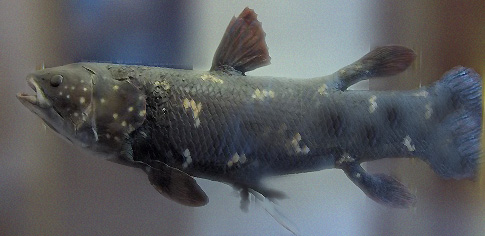 But you may want some more visually persuasive examples. Consider for a moment the playful otter. Moreover, consider the otter together with the seal, the sea-lion, and the walrus, coo coo c'choo. Lets not forget those magnificent manatees, or hip hippos. Remember our friends the whales? Evolution isn't just a thing of the past. It's a thing of right now.
At least once a day, I receive in my email one of those endlessly forwarded editions of one witticisms. They seem make their way from inbox to inbox like the common cold goes through an elementary school. I rarely take the time to read them anymore, and as a rule, I forward them only very selectively, when I have something to say about them. And though in some ways it will seem like a tired subject, I received one yesterday that I’m compelled to respond to, if only because it’s an idea I hear a little too often. What I read, partway through an otherwise innocuous list of queries about life, was this:
> If people evolved from apes, why are there still apes?
I can answer this one!
Because we didn't evolve from apes. We evolved from a common ancestor with apes, and subsequently filled differing, though overlapping ecological niches, both through a process of geographical isolation, and a process called punctuated evolution. Since humans have only been around for a few million years, it can hardly be said that that apes will survive our taking over of those ecological niches. We're competing directly with them for habitat, to say nothing of hunting them for meat or amusement, and we're winning on both counts. Neanderthals also evolved from those same common ancestors, and lived in competition with Homo Erectus (our ancestors), and Homo Sapiens (us). Neanderthals could probably offer you some insight into living in competition with Home Sapiens, but of course, they're extinct. In fact, at one time there may have been as many as five closely-related species of human in direct competition with each other. We are all that remain.
The process of evolution is neither as simple, nor as linear as the popular conception depicts. But if you take the time to study and understand it more fully, it's complexity is matched only by it's beauty.
Some years ago I visited a zoo in
For my part how was struck by how alike we are. They way he used his hands, the expressions he used with other chimps, and the simple way he could ignore the people behind the glass. Knowing they were there staring at him, and carrying on just the same with chasing bugs. Living in such close proximity to human beings hadn’t taught him any empathy for the multitude of faces behind the glass.
I was also reminded of a comment I’d once heard about evolution: “How could anyone look at a monkey and think we’re related.”
So I stood there asking myself that same question. And I came up with one answer: Empathy.
Driving my daughter to school in the morning, or on my way to work, everywhere I look, there are fish. I can’t help marveling at them; all those fish in silvery plastic schools. They’re the little plastic chromed fish you see on the tail ends of cars. There are plain fish, and fish that say “Jesus” or probably the same thing in Greek letters, but I don’t read enough Greek to know. There are “Darwin” fish with little legs on the bottom like lobe-fishes and a big fish proclaiming “Truth” eating little Darwin fish. There are still other fish standing upright, spearing the Truth Fish with tiny plastic harpoons. A veritable cosmological arms race is being played out before us with little metallic-colored plastic fish poised only inches away from trunk spaces carrying groceries from the same supermarkets.
There are flags and banners too, proclaiming the various “truths” precious to the people in front of these bumper battlegrounds. This one’s pro-choice, that one’s pro-life. This one thinks that as long as there are tests, there will be prayer in school, and that one kindly offers not to think in your church if you’ll not pray in their kids’ schools. One declares “TRUTH! NOT TOLERANCE!” and but for the little picture of the Bible and the cross, you couldn’t be sure which side they were on. But the battle over Evolution and Creationism is fought mostly by those little fish.
I won’t call it a “War” the way so many debates and struggles are labeled these days. This debate rarely wounds more than anyone’s pride, and the little fish don’t bleed, no matter how harsh their treatment by other fish, or well-aimed shopping carts in supermarket parking lots. But the tone of the debate often makes it seem that way, as if we’re in a desperate struggle for our survival in a total-war. They behave as if the adherents to one cause will at last prove their point beyond a shadow of a doubt with one last witty bumper sticker slogan too sage to refute, and the losers will somehow be as utterly destroyed as old Carthage, the ground salted so that nothing will ever grow in that soil again.
But we know better. The confrontation will never really be that fatalistic, and the debate will never come to so crisp an end. Evolution may take the place of Creationism in the popular imagination, as new knowledge so often displaces the old, but it won’t be the great coup that so many seem to fear. This conflict will have survivors on both sides, and we’re better prepared to handle the new paradigm than we know. The tools of reconstruction are already at hand.
It’s been suggested that some people resist the idea of evolution because they can’t accept the idea of being animals. But this isn’t really the case. We already acknowledge our evolutionary heritage in our daily conversation. After all, we all start out as ankle-biting rug-rats. We quickly grow into little monkeys. My own son learned to climb up the branches of dinning room chairs to forage for snacks on the table before he learned to walk upright, and with my children there’s no shortage of jumping on the bed. As they grow older their mother will regularly complain about how their rooms have turned into pig-sties, and at school field days, we’ll encourage them to run “fast as a race horse.”
As kids get older the animal descriptions grow with them. Some are kinder than others. A boy might one day call my daughter a “fox,” and she’ll probably appreciate it more than I will. I might think of him as a wolf in sheep’s clothing. Many of the names won’t be nice at all; skunk, porker, dog, male or otherwise. The class clown might be a real ham, who later in life will regret taunting that slightly overweight girl by calling her a cow, especially in college when he sees her again and finds out she was just a late bloomer, and she really did blossom, but by then, he’ll be too chicken to offer her an apology, let alone ask her on a date.
As we mature, we climb the evolutionary ladder just a bit, to become gangly apes, and if we’re lucky, Neanderthals. I’ve known two “Yetis” myself, much more at home with their animal monikers in adulthood than they probably were then they acquired them in their late teens. The modern cave man, reputedly obsessed with beer and football, and bereft of manners is the unremarkable resident of suburbs everywhere. And in a bit of what may be purposeful irony, proponents of Evolution often cite the brutish and superstitious picture of our hominid ancestry as the root cause of their Creationist opposition.
Perhaps Creationists fear that the end of creationism will mean the end of Gods and religious teachings. But this isn’t so either. Our culture is full of religious figures, icons and stories from religions that are out of style, and nothing more dramatic will happen with the religions of today. Many school children know the names of Zeus and Hera, Jupiter and Mars, and even the Mighty Thor. High school cheerleaders still invoke the name of Egyptian Gods in the name of the Home Team, “Ra! Ra! Ra!” OK, I’ll admit that’s probably a complete coincidence, but you understood the joke.
But God, Buddha, Jesus, Mohamed the Angels and others will probably enjoy a bigger role in our minds and culture than those relegated to the pages of mythology in earlier centuries. We’ll still see them more often than Santa Claus or the Easter Bunny, and they’ll probably continue to be better known than Socrates or Plato. The characters and stories are too well-known, and too comforting to be forgotten. The ancient texts are too full of fodder for creatures that enjoy metaphor as much as we do. Playgrounds will never run short of David and Goliath confrontations, and there are too many serpents offering forbidden fruit to let such stories go.
In all probability, the end of this controversy will probably be nothing more than the beginning of some other. The apes will finally become adults, and they’ll find they care about different things. When a friend asks about the little fish on the back of their old college beater-cars, they’ll say “Oh, I got the car from mom and dad. That was on there when they gave it to me.” And we’ll find the traces of both Evolution and Creationism are no easier to remove than peeling bumper stickers from an old car.
Yesterday I got a link from a friend about Google teaming up with the X Prize Foundation to sponsor a new Lunar X prize. The new prize sets a high goal for a privately funded organization to land a robotic rover on the moon, and have it perform a number of tasks on the surface. Perhaps more significant is the lineup of companies and organizations stepping up to form partnerships and participate.
It’s interesting to note how that spirit of cooperation contrasts with the days of the Space Race between the
That same day, I also saw an article about recent updates to the IUCN Red List of Threatened Species. Apes are among those species with dangerously declining numbers, and quickly vanishing habitat. Gorillas and Chimpanzees are in danger not only for loss of habitat, but also because they are hunted for meat. In spite of the faint whiff of cannibalism, the Chimps probably wouldn’t find this idea too strange if they were given to abstract reasoning. They are known to hunt smaller monkeys for their meat as well.
But like so many humans, the chimps don’t waste a lot of time thinking about the ethereal implications of eating other simians. They’re hungry, and they like the taste of meat. They probably like the chase too. They’re animals. Just like us. OK, 98% like us. But understanding them, and our relationship with them, past and present, is important. It puts things in perspective. While many protest that they aren’t “a monkey’s uncle,” our continued habit of treating each other with suspicion and cruelty without ever considering our commonality demonstrates our animal nature.
But many of the comparisons between ourselves and the great apes are more positive. Apes, hairless and otherwise, can be tender and caring. We can work cooperatively to great advantage. We have an uncanny ability to make and use tools from the simplest things. And our ingenuity can astound. After all, we’re descended from monkeys and look what we can do; we landed a monkey’s nephew on the moon.